
Legal and Legislative Updates
Maryland Family and Medical Leave Insurance Program
Maryland Family and Medical Leave Insurance Program
Md. Code Ann., Lab. & Empl. §§ 8.3-101 et seq.
Frequently Asked Questions
What Dates Should Employers Be Aware Of?
- The Maryland Family and Medical Leave Insurance Program (the “Law” or the “Program”) is effective January 1, 2023.
- The Maryland Secretary of Labor is responsible for adopting regulations by June 1, 2023.
- Contributions: Employees, employers with 15 or more employees, and self-employed individuals will begin contributing to the Fund on October 1, 2023.
- Benefits: Beginning January 1, 2025, employees taking leave under the Law will receive partial wage replacement from $50 to $1,000 per week, depending on their regular rate of pay.
What Employers Are Covered?
- Any public or private entity that employs at least one individual in Maryland. (§ 8.3-101(h))
- Self-employed individuals can choose to participate in the Program.
- Private Employer Plan / Exemption: Employers may seek an exemption from Program participation if they can establish that they provide eligible employees benefits and/or insurance that meets or exceeds the benefits and protections under the Program. Employers must submit their plan for review and approval from the Maryland Department of Labor, Licensing and Regulation (DLLR). If the private plan is approved, the employer is exempt from contributions to the Fund. (§ 8.3-705)
Who Gets Paid Leave?
- Employees who have worked at least 680 hours over the 12-month period immediately preceding the date on which the employee’s leave is to begin (the application year). (§ 8.3-101(d))
- The application year is the 12-month period beginning on the first day of the calendar week in which a covered individual files an application for benefits under the Program. (§ 8.3-101(b))
What Are The Benefits Of The Act?
- Leave Amount and Reasons: The Act offers up to 12 weeks of paid time off per year for the
following reasons:- to care for a new child (birth, adoption, fostered) for the first year after birth or placement;
- for an employee’s serious health condition that results in the covered individual being unable to perform the functions of the covered individual’s position;
- to care for a family member with a serious health condition;
- to care for a service member with a serious health condition resulting from military service who is the covered individual’s next of kin; or
- because the covered individual has a qualifying exigency arising out of deployment of a
service member who is a family member of the covered individual. (§§ 8.3-302; 8.3-701; 8.3-
702)
- There are certain instances when an employee may get up to 24 weeks of paid leave, such as if medical leave is needed during pregnancy followed by parental leave after childbirth. (§ 8.3-702)
- Leave under the Program is concurrent with FMLA leave. (§ 8.3-702)
- Job Protection: Employees have job protection while out on leave and employers must “restore the covered individual to an equivalent position of employment” upon return from leave except under specific circumstances. (§ 8.3-706)
- While an employee is on leave for which benefits may be paid, the employee may only be terminated for cause.
- An employer may deny job restoration if:
- the denial is necessary to prevent substantial and grievous economic injury to the operations of the employer;
- the employer notifies the covered individual of the intent of the employer to deny restoration of the covered individual’s position of employment at the time the employer determines the economic injury would occur; and
- if the leave has already begun (and benefits are payable), the covered individual elects not to return to employment after receiving notice of the employer’s intention to deny restoration of the covered individual’s position of employment.
- Benefits Continuation: Employer health benefits must be continued while an employee is receiving benefits under the Program. (§ 8.3-707)
- Serious Health Condition: The Law defines “serious health condition” as an illness, an injury, an impairment, or a physical or mental condition that involves:
- inpatient care in a hospital, hospice, or residential health care facility;
- continued treatment by a licensed health care provider; or
- continued treatment or supervision at home by a licensed health care provider or other competent individual under the supervision of a licensed health care provider. “Serious health condition” includes an illness, an injury, an impairment, or a physical or mental condition described above that continues over an extended time and requires intermittent treatment. (§ 8.3-101(o))
- Family Member: The definition of “family member” is:
- a biological child, an adopted child, a foster child, or a stepchild of the covered individual;
- a child for whom the covered individual has legal or physical custody or guardianship;
- a child for whom the covered individual stands in loco parentis, regardless of the child’s age;
- a biological parent, an adoptive parent, a foster parent, or a stepparent of the covered individual or of the covered individual’s spouse;
- the legal guardian of the covered individual or the ward of the covered individual or of the covered individual’s spouse;
- an individual who acted as a parent or stood in loco parentis to the covered individual or the covered individual’s spouse when the covered individual or the covered individual’s spouse was a minor;
- the spouse of the covered individual;
- a biological grandparent, an adopted grandparent, a foster grandparent, or a stepgrandparent of the covered individual;
- a biological grandchild, an adopted grandchild, a foster grandchild, or a stepgrandchild of the covered individual; or
- a biological sibling, an adopted sibling, a foster sibling, or a stepsibling of the covered individual. (§ 8.3-101(i))
- Qualifying Exigency: A “qualifying exigency” means certain reasons for leave needed by a family member of a service member:
- because the service member has received notice of deployment within 7 days before the deployment is to begin;
- to attend military events and related activities including family support programs related to the active duty of the service member;
- to arrange, provide, or attend child care or school activities only when the service member is on active duty call or active duty status;
- to make financial and legal arrangements for the service member’s absence or because of the absence;
- to attend counseling that:
- is needed due to the active duty or call to active duty status of the service member; and
- is provided by an individual who is not a licensed health care provider;
- to spend up to 15 calendar days with a service member who is on short-term temporary rest and recuperation leave during the period of deployment;
- to attend post-deployment activities including reintegration services for a period of 90 days immediately following the termination of active status;
- to attend to matters related to the death of the service member while on active duty status;
- to arrange for or provide alternative care for a parent of the service member when the parent is incapable of self-care and the covered active duty or call to active duty necessitates a change; or
- because of any other issues that arise out of active duty or a call to active duty that an employer and covered employee agree should be covered. (§ 8.3-101(m))
How Are The Paid Leave Benefits Funded?
- The Family and Medical Leave Insurance Fund (the Fund) will source the paid leave benefits. The Fund is financed by a payroll tax paid by both employers (those with 15 or more employees) and employees. (§ 8.3-503)
- The payroll tax (rate to be determined) will go into effect on October 1, 2023. (§ 8.3-601)
How Do Employees Receive The Paid Leave Benefit?
- Eligible employees must submit an application for benefits to DLLR. The application for benefits must include: (1) the date on which the reason for leave commenced; (2) the probable duration of the condition; (3) facts regarding the condition as provided by a healthcare provider; (4) a statement regarding the need for leave; and (5) a certification regarding intermittent leave (if applicable). (§ 8.3-403)
- DLLR will notify an employer within five (5) business days after filing that an employee has filed a claim for benefits. (§§ 8.3-403; 8.3-703)
- Employees must exhaust all employer-provided leave that is not required by law before receiving Program benefits. (§§ 8.3-702; 8.3-703)
- Employees may seek benefits beginning January 1, 2025. (8.3-703)
How Much Pay Will Employees Receive?
- The benefits replace 90% of weekly wages for the lowest-income wage earners. There is a decreasing percentage of wages paid as an employee’s income increases. The lowest paid workers get a minimum of $50/week; the highest paid workers are capped at $1,000/week. (§ 8.3-703)
- Average weekly wage means the total wages an employee receives over the prior 680 hours divided by the number of weeks worked. (§ 8.3-703)
How Can Employees Access Program Benefits?
- Continuous or Intermittent Leave: Leave may be continuous or intermittent. If intermittent, leave must be taken in no less than 4-hour increments, reasonable prior notice must be provided, and the
employee must make a reasonable effort to schedule the leave in a manner that does not unduly disrupt the employer’s operations. (§ 8.3-701) - Foreseeable Leave: If the need to use leave is foreseeable, an employer may require an employee taking leave to provide the employer with written notice of the employee’s intention to take leave at least 30 days before commencing the leave. (§ 8.3-701)
- Unforeseeable Leave: If the need to use leave is not foreseeable, the employee must provide notice to the employer as soon as practicable and generally comply with the employer’s notice or procedural requirements for requesting or reporting other leave, if those requirements do not interfere with the employee’s ability to use leave for which benefits may be paid under the Program. (§ 8.3-701)
Is There A Notice/Posting Requirement?
- Time of Hire & Annually: Employers are required to provide written notice to each employee of their rights and duties under the Act. Notice must be provided at the time of hire and annually. (§ 8.3-801)
- When Employer Has Knowledge: Employers must also provide notice when they know that an employee’s leave may be for a covered reason. In this situation, the employer must notify the employee of the employee’s eligibility to take leave covered by the Program within five (5) business days. (§ 8.3-801)
- Notice Contents: The notice must include:
- the right to receive benefits
- the procedures for filing a claim for benefits
- the employee’s responsibilities regarding notification prior to leave and penalties for noncompliance
- the employee’s right to file a complaint for alleged violations
- the employee’s right to job protection, and
- a description of prohibited acts and related penalties. (§ 8.3-801)
What Are The Rules Regarding Disclosure Of Information?
- DLLR will not disclose information relating to an individual who has applied for or received Program benefits except to:
- a public employee in the performance of the public employee’s official duties;
- the individual to whom the information relates; or
- if an authorized representative has the signed authorization of the individual to whom the
- information relates, the authorized representative. (§ 8.3-102)
Are Local Governments Permitted To Enact A Paid Family Leave Law?
- No. The Law precludes local jurisdictions from enacting, on June 1, 2022 or later, a paid family and medical leave insurance program that is applicable to employers other than the local jurisdiction itself. (§ 8.3-102)
What Are The Rules Regarding Discrimination And Retaliation?
- It is unlawful to discharge, demote, or otherwise discriminate or retaliate against an individual because that person has:
- filed for, applied for, or received benefits, or taken family or medical leave under the Program;
- inquired about the rights and responsibilities under the Program;
- communicated to the person an intent to file a claim, a complaint, or an appeal under the Program; or
- testified or intends to testify or otherwise has assisted in a proceeding under the Law. (§ 8.3-
904)
How Are Non-Compliance, Errors, Complaints, Penalties, And Appeals Addressed?
- Failure to Make Contributions: If an employer does not pay the required contributions, the Secretary may assess the amount due (plus interest), assess an additional amount up to two times the contribution withheld, and order an audit of the employer. (§ 8.3-903)
- Benefits Repayment: DLLR may seek repayment of benefits paid under the Program where the benefits were paid in error or as a result of willful misrepresentation, or a claim for benefits is rejected after benefits were paid. The Secretary may waive repayment if the error was not the result of a false statement, non-disclosure of material fact, or misrepresentation, or the repayment would be “against equity and good conscience or administrative efficiency.” (§ 8.3-902).
- False Statements: An individual who willfully makes a false statement or misrepresentation regarding a material fact or willfully fails to report a material fact to obtain benefits under the Program will be disqualified from receiving benefits for a year. An employer who willfully makes or causes a false statement to be made or willfully fails to report a material fact is subject to a $1,000 civil penalty per occurrence. Employers are not permitted to willfully fail or refuse to pay contributions to the Fund or willfully take deductions from employee wages to pay the employer’s contributions. (§ 8.3-901)
- Complaints and Private Right of Action: Employees who believe that an employer has violated the Program’s requirements may file a written complaint with the DLLR Secretary. (§ 8.3-905)
- The Secretary must conduct an investigation within 90 days and attempt to informally resolve the issue through mediation.
- The Secretary may issue an order addressing lost wages and damages, benefits, and other compensation, including economic damages; and seek reinstatement.
- The Secretary may assess a civil penalty of up to $1,000 for each employee for whom the employer is not in compliance.
- If an employer does not comply with an order, the Secretary may ask the Attorney General to bring an action on behalf of the employee or bring an action directly.
- An employee may bring an action within three (3) years after the date of the order.
- An employee who prevails in an action may be awarded treble damages, punitive damages, reasonable counsel fees and costs, injunctive relief, and any other appropriate relief.
- Appeals: The DLLR Secretary will establish a system for appeals for those who are denied benefits under the Program. The appropriate Maryland circuit court will be able to review decisions once administrative remedies are exhausted. (§ 8.3-906)
What Should Employers Do Now?
- Review your current paid leave policies to assess if you already provide benefits that meet or exceed those required by the Act. If you do not, assess whether you want to change your policies to seek and qualify for an exemption.
- If you will not be participating in the Fund, be ready to submit your policies to DLLR with sufficient time to get exempted before the October 1, 2023 payroll tax contribution obligation begins.
- If you will be participating in the Fund, remain abreast of all updates and developments, including the contribution rates, notice and posting requirements, and contents and requirements of the anticipated regulations.
- If you will be participating in the Fund, be ready to implement the payroll tax on October 1, 2023, and provide timely notice to employees of their benefits, rights and responsibilities under the Act
Vaccine Mandate Update
The world of vaccine mandates is confusing to many and often, the interpretation can be skewed by the beliefs of the persons impacted by a policy or regulation. As of the end of 2021, there were four federal mandates in play. They were OSHA’s emergency temporary standard that applied to employers with more than 100 employees; a mandate from the Department of Health and Human Services pertaining to health care providers (known as the “CMS mandate”), a mandate applying to Head Start agencies, and finally, a mandate for federal contractors.
Here is where they stand as of February 1, 2022, in short summary:
The U.S. Supreme Court upheld the injunction staying the ETS on January 13, 2022 with nationwide effect. OSHA has since withdrawn that standard, but promises that a final standard will be forthcoming;
The CMS mandate remains in place, pending a challenge. The U.S. Supreme Court refused to block the mandate by its order issued on January 13, 2022:
The Head Start mandate was temporarily block in 24 states as of January 1, 2022. For the CVSHRM audience, the stay applies to West Virginia employers, but NOT those in Maryland or Pennsylvania.;
Finally, the federal contractor mandate is stayed nationwide. Note, the stay applies only to the vaccine component of the Executive Order: social distancing, masking components, travel and quarantine components remain in place.
Legal & Legislative Lunch and Learn Series!
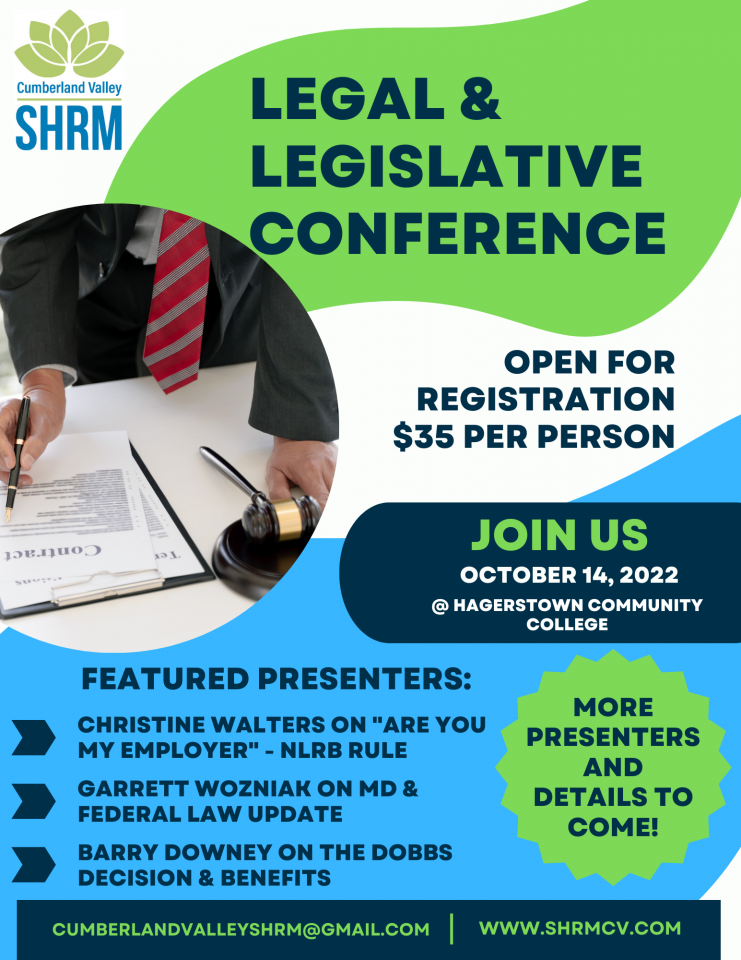
Cumberland Valley SHRM is hosting their annual Legal & Legislative Conference a bit differently this year. We will be be offering three virtual sessions throughout October and November during lunchtime, by signing up for all three sessions you can receive a discounted registration fee!
Details:
When: Wednesday October 20, October 27, and November 3, 2021
Time: 12:00 - 1:30 PM
Credits: 1.5 SHRM & HRCI Credits per session (4.5 credits overall)
Presenters/Topics:
-
Christine Walters - A Top Ten List of HR & Employment Law Hot Topics
-
Adam Meehan - The Flurry Of Laws And Regulations That Have Impacted Employee Benefit Plans
-
Garrett Woznial - Maryland and Federal Employment Law Update
Registration Fee: $15 per session and $30 for entire series for CVSHRM Members, $25 per session and $50 for entire series for Non-CVSHRM Members
Register today!
American Rescue Plan (ARP) Provides temporary premium assistance for COBRA
Individuals may be eligible for premium assistance if they are eligible for and elect COBRA continuation coverage because of their own or a family member’s reduction in hours or an involuntary termination from employment. This premium assistance is available for periods of coverage from April 1, 2021 through September 30, 2021. This premium assistance is generally available for continuation coverage under the Federal COBRA provisions, as well as for group health insurance coverage under comparable state continuation coverage (“mini-COBRA”) laws.
Find more information by Clicking HERE
Maryland House Lawmakers Advance Narrower Essential Worker Protection Legislation
A heavily amended version of House Bill 581, an emergency bill to protect essential workers during public health emergencies was introduced to the Senate on April 5, 2021. The amended measure curtails who counts as an essential worker, provides for paid sick leave if federal or state funding is made available to employers and no longer includes hazard pay. With time counting down in the legislative session, the bill faces a tight timeline for final passage.
Bill HB 289: Peace Orders - Workplace Violence Bill moving forward in the legislative process
This bill would allow an employer to get a peace order for an act of abuse that occurred at the workplace against an employee so long as the employee does not have the kind of relationship with the abuser that would allow her/him to get a protective order.
What is a Peace Order?
The Peace Order is a form of legal protection for anyone who is experiencing problems with an individual, including someone in a dating relationship, a neighbor, a stranger, or anyone else. The Peace Order enables an individual (Petitioner) who wishes to be left alone to ask the Court to order another person (Respondent) to stay away and refrain from any contact with you. This article is a step-by-step guide to help you protect yourself.
CLICK HERE for more info
Senate Bill 834 - Harassment & Sexual Harassment
Per MD SHRM:
-
We are not taking an active position against this given all employers should want civil workplaces free of sexual harassment
-
We are going to continue to advocate for more clarity on what constitutes harassment; the vague language is problematic
The bill passed the senate and was sent to the House where it was sent to the Economic Matters committee and no further action has been taken since the hearing on March 30, 2021.
CLICK HERE for more info
